

Should I Clean Install Windows On Helios 300
Eclipse for Java
How To Install Eclipse and Get Started with Java Programming
(on Windows, macOS and Ubuntu)
Eclipse (@ www.eclipse.org) is an open-source Integrated Development Environment (IDE) supported past IBM. Eclipse is popular for Java application evolution (Coffee SE and Java EE) and Android apps. It also supports C/C++, PHP, Python, Perl, and other web project developments via extensible plug-ins. Eclipse is cross-platform and runs under Windows, Linux and macOS.
Eclipse Versions
The diverse versions are:
- Eclipse 1.0 (November vii, 2001): based on an earlier Coffee IDE chosen VisualAge from IBM.
- Eclipse 2.0 (June 28, 2002)
- Eclipse two.1 (March 28, 2003)
- Eclipse three.0 (June 25, 2004)
- Eclipse 3.i (June 28, 2005)
- Eclipse 3.ii (June 30, 2006) (Callisto - named after 1 of the Jupiter's Galilean moons): started annual simultaneous release of all the related Eclipse projects.
- Eclipse 3.3 (June 25, 2007) (Europa - named after another Jupiter'due south Galilean moons)
- Eclipse 3.4 (June nineteen, 2008) (Ganymede - named later yet another Jupiter'southward Galilean moons)
- Eclipse 3.5 (June 12, 2009) (Galileo - named after the nifty 17th century scientist and astronomer Galileo Galilei)
- Eclipse three.six (June 23, 2022) (Helios - named after god of the sun in Greek Mythology)
- Eclipse iii.vii (June 23, 2011) (Indigo)
- Eclipse 4.2 (June 27, 2022) (Juno)
- Eclipse four.iii (June 2022) (Kepler)
- Eclipse iv.4 (June 2022) (Luna)
- Eclipse 4.5 (June 2022) (Mars)
- Eclipse four.half-dozen (June 2022) (Neon)
- Eclipse 4.seven (June 2022) (Oxygen)
- Eclipse 4.8 (June 2022) (Photon)
- Eclipse 2022-09 (4.ix) (starting quarterly release), Eclipse 2022-12 (4.ten)
- Eclipse 2022-03 (four.xi), Eclipse 2022-06 (four.12), Eclipse 2022-09 (4.thirteen), Eclipse 2022-12 (4.xiv)
- Eclipse 2022-03 (4.15), Eclipse 2022-06 (iv.16), Eclipse 2022-09 (four.17), Eclipse 2022-12 (4.eighteen)
- Eclipse 2022-03 (iv.19), Eclipse 2022-06 (four.20), Eclipse 2022-09 (4.21), Eclipse 2022-12 (4.22)
- Eclipse 2022-03 (4.23)
How to Install Eclipse IDE 2022-12 for Java Developers
How to Install Eclipse on Windows
Step 0: Install JDK
To utilise Eclipse for Java programming, you demand to beginning install Java Development Kit (JDK). Read "How to Install JDK for Windows".
Stride 1: Download
Download Eclipse from https://www.eclipse.org/downloads/packages/. Cull "Eclipse IDE for Java Developers" and "Windows x86_64" (e.thousand., "eclipse-java-2021-12-R-win32-x86_64.naught" - about 313MB) ⇒ Download.
Step 2: Unzip
To install Eclipse, simply unzip the downloaded file into a directory of your choice (eastward.1000., "c:\myProject").
I prefer the zip version, because in that location is no need to run whatsoever installer. Moreover, you can simply delete the entire Eclipse directory when information technology is no longer needed (without running any united nations-installer). You are free to move or rename the directory. You can install (unzip) multiple copies of Eclipse in the same machine.
How to Install Eclipse on macOS
To use Eclipse for Java programming, you lot need to get-go install JDK. Read "How to install JDK for macOS".
To install Eclipse:
- Goto http://world wide web.eclipse.org/downloads/package/. Choose "Eclipse IDE for Coffee Developers" and "macOS x86_64" (for Intel processor). You will receive a DMG file (e.thousand., "
eclipse-java-2021-12-R-macosx-cocoa-x86_64.dmg"). - Double-click the downloaded Disk Image (DMG) file. Follow the screen instructions to install Eclipse. Eclipse will be installed under "
/Applications/eclipse". (To confirm!)
How to Install Eclipse on Ubuntu Linux
Eclipse comes with many flavors (Meet "Eclipse Packages" @ https://world wide web.eclipse.org/downloads/compare.php):
- To use Eclipse for Java programming, choose "Eclipse IDE for Java Developers" (JavaSE) or "Eclipse IDE for Java EE Developers" (JavaEE). You need to get-go install JDK. Read "How to install JDK on Ubuntu".
- To use Eclipse for PHP programming, choose "Eclipse IDE for PHP Developers".
- To apply Eclipse for C/C++ programming, choose "Eclipse IDE for C/C++ Developers".
Nonetheless, y'all can install whatsoever parcel, and and then add more than features when needed.
To install Eclipse (due east.yard, for Java Programming):
- Download Eclipse from http://www.eclipse.org/downloads/. Under "Get Eclipse IDE 2022-12" ⇒ Click the link "Download Packages" (instead of pushing the button "Download x86_64"). Choose "Eclipse IDE for Java Developers" for Java SE program development; or "Eclipse IDE for Java EE Developers" for developing webapps ⇒ Linux x86_64. You lot will receive a tarball (eastward.g., "
eclipse-java-2020-12-R-linux-gtk-x86_64.tar.gz") in the "~/Downloads" folder. - We shall install Eclipse under
/usr/local.$ cd /usr/local $ sudo tar xzvf ~/Downloads/eclipse-coffee-2020-12-R-linux-gtk-x86_64.tar.gz $ cd /usr/bin $ sudo ln -s /usr/local/eclipse/eclipse $ ls -ld /usr/bin/eclipse lrwxrwxrwx ane root root 26 Aug 30 11:53 /usr/bin/eclipse -> /usr/local/eclipse/eclipse $ which eclipse /usr/bin/eclipse
To run Eclipse, open the "/usr/local/eclipse" folder and click on the "Eclipse" icon; or beginning a "Terminal", enter "eclipse".
Lock Eclipse on Launcher
Simply start Eclipse. Right-click the Eclipse icon ⇒ "Lock to Launcher" or "Add to Favourite".
(For older version - If the in a higher place don't piece of work) Create a /usr/share/applications/eclipse.desktop file with the post-obit contents:
[Desktop Entry] Proper noun=Eclipse Blazon=Application Exec=eclipse Last=fake Icon=/usr/local/eclipse/icon.xpm Comment=Integrated Development Environs NoDisplay=fake Categories=Development;IDE; Name[en]=Eclipse
First Eclipse, right-click on the Eclipse icon on launcher ⇒ "Lock to launcher".
Writing your Get-go Java Plan in Eclipse
Step 0: Launch Eclipse
- Launch Eclipse past running "
eclipse.exe" from the Eclipse installed directory. - Choose an appropriate directory for your workspace, i.due east., where yous would similar to save your files (e.g.,
c:\myProject\eclipsefor Windows) ⇒ Launch. - If the "Welcome" screen shows upwards, close it past clicking the "close" button next to the "Welcome" title.
Step 1: Create a new Java Project
For each Java awarding, you demand to create a project to keep all the source files, classes and relevant resources.
To create a new Java projection:
- Cull "File" menu ⇒ "New" ⇒ "Java projection" (or "File" ⇒ "New" ⇒ "Projection" ⇒ "Java project").
- The "New Java Project" dialog pops up.
- In "Project name", enter "
FirstProject". - Cheque "Utilise default location".
- In "JRE", select "Use an execution environment JRE (JavaSE-17). Brand sure that your JDK is eleven and above.
- In "Project Layout", check "Use projection folder as root for sources and class files".
- In "Module", UNCHECK "Create module-info.coffee" file.
- In "Project name", enter "
- IF "Create module-info.coffee" dialog appears, Click "Don't Create".
Footstep two: Write a Howdy-world Java Program
- In the "Package Explorer" (left pane) ⇒ Right-click on "
FirstProject" (or use the "File" menu) ⇒ New ⇒ Class. - The "New Java Class" dialog pops up.
- In "Source folder", continue the "FirstProject".
- In "Parcel", leave it EMPTY. Delete the content if it is not empty.
- In "Name", enter "
Hello". - Check "
public static void main(String[] args)". - Don't change the residuum.
- The source file "
How-do-you-do.java" opens on the editor console (the center pane). Enter the following codes:public class How-do-you-do { public static void master(String[] args) { Organisation.out.println("How-do-you-do, world!"); } }
Step 3: Compile & Execute the Coffee Program
- There is no need to compile the Coffee source file in Eclipse explicitly. It is considering Eclipse performs the and then-chosen incremental compilation, i.e., the Coffee statement is compiled every bit and when it is entered.
- To run the program, right-click anywhere on the source file "
Hello.coffee" (or choose "Run" carte) ⇒ Run As ⇒ Coffee Application. - The output "Howdy, world!" appears on the Console panel (the lesser pane).
NOTES:
- You should create a NEW Java project for EACH of your Java application.
- Nonetheless, Eclipse allows you to keep more than than ane programs in a project, which is handy for writing toy programs (such as your tutorial exercises). To run a particular program, open and right-click on the source file ⇒ Run Every bit ⇒ Java Awarding.
- Clicking the "Run" button (with a "Play" icon) runs the recently-run program (based on the previous configuration). Endeavor clicking on the "down-pointer" besides the "Run" button.
Correcting Syntax Errors
Eclipse performs incremented compilation, as and when a source "line" is entered. Information technology marked a source line having syntax error with a RED Cantankerous. Place your cursor at the Cherry Cantankerous to view the error message.
You CANNOT RUN the program if there is any syntax error (marked by a RED CROSS before the filename). Correct all the syntax errors; and RUN the program.
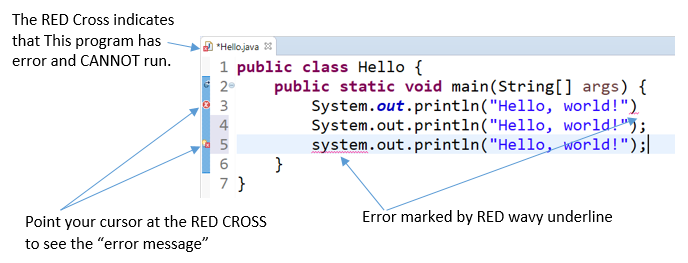
HINTS: In some cases, Eclipse shows a Orange LIGHT-Seedling (for HINTS) next to the ERROR Blood-red-Cantankerous (Line 5 in the in a higher place diagram). You tin click on the Low-cal-Seedling to get a list of HINTS to resolve this particular error, which may or may not work!
SYNTAX Alert: marked past a orange triangular exclaimation sign. Different errors, warnings may or may non cause bug. Effort to fix these warnings as well. But you lot can RUN your program with warnings.
Read the Eclipse Documentation
At a minimum, you SHOULD browse through Eclipse'due south "Workbench User Guide" and "Coffee Development User Guide" - accessible via the Eclipse'due south "Welcome" page or "Assistance" carte. This will save you lot many disturbing hours trying to figure out how to do somethings later.
Debugging Programs in Eclipse
Able to use a graphics debugger to debug programme is crucial in programming. Information technology could relieve you countless hours guessing on what went wrong.
Step 0: Write a Coffee Program
The following plan computes and prints the factorial of north (=1*2*3*...*n ). The plan, however, has a logical error and produce a wrong answer for n =20 ("The Factorial of 20 is -2102132736" - a negative number?!).
one 2 3 iv 5 vi 7 eight 9 10 11 12 13 xiv 15 16 | public class Factorial { public static void chief(String[] args) { int due north = 20; int factorial = i; int i = 1; while (i <= n) { factorial = factorial * i; i++; } System.out.println("The Factorial of " + n + " is " + factorial); } } |
Let'south utilize the graphic debugger to debug the program.
Step ane: Fix an Initial Breakpoint
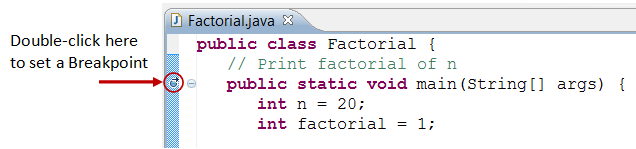
A breakpoint suspends program execution for you to examine the internal states (e.grand., value of variables) of the program. Before starting the debugger, y'all need to ready at least one breakpoint to suspend the execution inside the program. Set a breakpoint at main() method past double-clicking on the left-margin of the line containing main(). A blue circumvolve appears in the left-margin indicating a breakpoint is set at that line.
Footstep ii: First Debugger
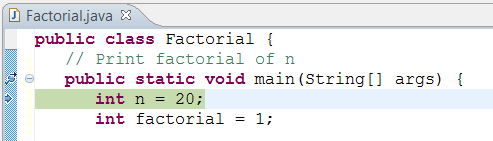
Right click anywhere on the source lawmaking (or from the "Run" menu) ⇒ "Debug Equally" ⇒ "Java Application" ⇒ choose "Yeah" to switch into "Debug" perspective (A perspective is a item arrangement of panels to suits a certain evolution task such as editing or debugging). The programme begins execution but suspends its functioning at the breakpoint, i.east., the main() method.
As illustrated in the following diagram, the highlighted line (also pointed to by a blueish arrow) indicates the statement to be executed in the next pace.
Footstep 3: Step-Over and Watch the Variables and Outputs
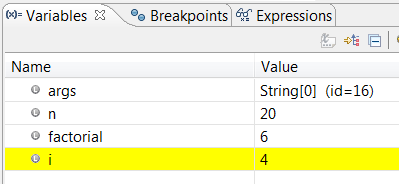
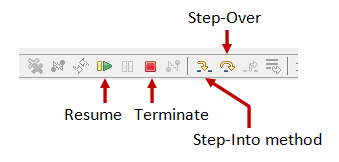
Click the "Step Over" button (or select "Footstep Over" from "Run" carte du jour) to single-stride thru your programme. At each of the step, examine the value of the variables (in the "Variable" panel) and the outputs produced past your program (in the "Panel" Panel), if any. You tin can also place your cursor at any variable to inspect the content of the variable.
Unmarried-stepping thru the program and watching the values of internal variables and the outputs produced is the ultimate mean in debugging programs - because it is exactly how the estimator runs your program!
Stride 4: Breakpoint, Run-To-Line, Resume and Finish
As mentioned, a breakpoint suspends program execution and let y'all examine the internal states of the plan. To fix a breakpoint on a detail argument, double-click the left-margin of that line (or select "Toggle Breakpoint" from "Run" carte).
"Resume" continues the plan execution, up to the next breakpoint, or till the end of the program.
"Unmarried-step" thru a loop with a large count is fourth dimension-consuming. You could set a breakpoint at the statement immediately outside the loop (e.m., Line 11 of the above program), and result "Resume" to complete the loop.
Alternatively, you lot can place the cursor on a item argument, and issue "Run-To-Line" from the "Run" menu to continue execution upwardly to the line.
"Terminate" ends the debugging session. Always terminate your current debugging session using "Terminate" or "Resume" till the finish of the program.
Step 5: Switching Back to Java perspective
Click the "Java" perspective icon on the upper-right corner to switch dorsum to the "Java" perspective for further programming (or "Window" carte du jour ⇒ Open Perspective ⇒ Java).
Important: I can'southward stress more that mastering the use of debugger is crucial in programming. Explore the features provided past the debuggers.
Other Debugger's Features
Step-Into and Pace-Return: To debug a method, you demand to use "Step-Into" to step into the starting time statement of the method. ("Step-Over" runs the role in a single step without stepping through the statements inside the part.) You lot could utilize "Step-Return" to return dorsum to the caller, anywhere inside the method. Alternatively, you could set a breakpoint inside a method.
Modify the Value of a Variable: Yous can modify the value of a variable by entering a new value in the "Variable" panel. This is handy for temporarily modifying the behavior of a program, without changing the source code.
Tips & Tricks
General Usages (for all Programming Tasks)
These are the features that I detect to exist almost useful in Eclipse:
- Maximizing Window (Double-Clicking): You can double-click on the "header" of any console to maximize that particular panel, and double-click again to restore information technology back. This characteristic is peculiarly useful for writing source code in full panel.
- Shorthand Templates (sysout, for,...): You can type "
sysout" followed past a ctrl+space (or alt-/) as a autograph for typing "Arrangement.out.println()".
The default shortcut primal (ctrl-infinite or alt-/) depends on the organisation. Bank check your system'due south shortcut key setting in "Edit" ⇒ "Content Aid" ⇒ "Default". Take annotation that many of you lot use ctrl+space to switch betwixt input languages. You need to reconfigure either your language switching hot-key or Eclipse.
Similarly, you tin can type "for" followed past ctrl-space (or alt-/) to get a for-loop.
Y'all can create your ain autograph in "Window" menu ⇒ "Preferences" ⇒ "Java" ⇒ "Editor" ⇒ "Templates". (Alternatively, in "Window" ⇒ "Preferences" ⇒ type "template" as filter text and choose "Java" ⇒ "Editor" ⇒ "Templates".)
You tin alter your key settings in "Window" card ⇒ "Preferences" ⇒ "General" ⇒ "Cardinal" ⇒ choose "Command", "Content Assist". (Alternatively, in "Window" ⇒ "Preferences" ⇒ type "key" as filter text and choose "General" ⇒ "Key".) - Intelli-Sense (ctrl-infinite): You lot tin can employ ctrl-space to activate the "intelli-sense" (or content assistance). That is, Eclipse volition offer you the choices, while yous are typing.
- Source Formatting (ctrl-shift-f): Correct-click on the source. Choose "Source" ⇒ "Format" to permit Eclipse to layout your source codes with the proper indentation.
- Source Toggle Comment (ctrl-/): To comment/uncomment a block of codes, choose "Source" ⇒ "Toggle Comment".
- Hints for Correcting Syntax Fault: If there is a syntax error on a argument, a cerise mark will prove up on the left-margin on that statement. Yous could click on the "light bulb" to brandish the error message, and too select from the available hints for correcting that syntax error.
- Refactor (or Rename) (alt-shift-r): You tin can rename a variable, method, class, parcel or even the project hands in Eclipse. Select and right-click on the entity to exist renamed ⇒ "Refactor" ⇒ "Rename". Eclipse can rename all the occurrences of the entity.
- Line Numbers: To show the line numbers, cull "Window" menu ⇒ "Preferences" ⇒ "Full general" ⇒ "Editors" ⇒ "Text Editors" ⇒ Check the "Show Line Numbers" Box. You tin can too configure many editor options, such as the number of spaces for tab. Alternatively, you lot tin can right-click on the left-margin, and bank check "Evidence Line Numbers".
- Error Message Hyperlink: Click on an error message will hyperlink to the corresponding source argument.
- Changing Font Type and Size: From "Window" card ⇒ "Preferences" ⇒ "Full general" ⇒ "Appearance" ⇒ "Colors and Fonts" ⇒ aggrandize "Java" ⇒ "Java Editor Text Font" ⇒ "Edit". (Alternatively, in "Window" ⇒ "Preferences" ⇒ type "font" equally filter text and cull the appropriate entry.)
- Unicode Support: To enable Unicode support, select "Window" menu ⇒ Preferences ⇒ General ⇒ Workspace ⇒ Text file encoding ⇒ UTF-8. This sets the default grapheme set used for file encoding, similar to VM's command-line selection
-Dfile.encoding=UTF-8. Usually used charsets for Unicode are UTF-8, UTF-16 (with BOM), UTF-16BE, UTF-16LE. Other charsets are US-ASCII, ISO-8859-ane. - Mouse Hover-over: In debug mode, yous could configure to show the variable's value when the mouse hovers over the variable. Select "Window" card ⇒ "Preferences" ⇒ "Java" ⇒ "Editor" ⇒ "Hover".
- Comparing Two Files: In "Package Explorer", select 2 files (concur the control key) ⇒Right-click ⇒ Compare with.
- Setting Keyboard Shortcut Keys: Y'all can set/change the keyboard shortcut keys at "Window" ⇒ "Preferences" ⇒ "General" ⇒ "Key".
I like to set the frequently-used commands to Ctrl-1 to Ctrl-10, for examples, "Run Coffee Application" to "Ctrl-1", etc. - Useful Eclipse Shortcut Keys:
- F3: Goto the declaration of the highlighted variable/method.
- Ctrl-Shift-G: Search for ALL references of the highlighted variable/method in workspace.
- Ctrl-Yard: Search for the Declaration of a variable/method in workspace.
Don't use Find (Ctrl-F), merely use the above context-sensitive search. - Ctrl-Shift-F: Format the source lawmaking.
- Ctrl-Shift-O: Organize imports.
- Alt-Shift-R: Rename. (Don't use Find/Supersede.)
- Ctrl-Space: auto-complete.
- Package Explorer vs. Navigator: We usually use "Package Explorer" in programming, only it will non testify y'all all the folders and files under the project. On the other hand, "Navigator" is a file manager that shows the exact file construction of the projection (similar to Windows Explorer). You can enable the Navigator by "Window" ⇒ Show view ⇒ Navigator.
- Spell Check: To enable spell check, select Window ⇒ Preferences ⇒ blazon "spell" in the filter ⇒ General ⇒ Editors ⇒ Text Editors ⇒ Spelling ⇒ Check "Enable spell checking". Also provide a "User defined dictionary" (with an initially empty text file).
To correct mis-spell words, right-click and press ctrl-1 (or Edit carte du jour ⇒ Quick Gear up). - Eclipse's Log File: Goto Assist ⇒ about Eclipse ⇒ Installation details ⇒ Configuration ⇒ View Error Log.
- Viewing two files in split screen: Merely click and hold on the title of ane file and drag it to the lower side of the screen. [To view the same file on split screen, create a new editor window by selecting Window ⇒ New Editor; and drag one window to the lower side of the screen.]
- Block Select (Cavalcade Select): Push Alt-Shift-A to toggle between block-select style and normal mode.
- Snippets:
- To view the snippet window: choose "Window" ⇒ Show View ⇒ Snippets.
- To create a new snippet category: Correct-click ⇒ Customize ⇒ New.
- To create a new snippet particular: Copy the desired text ⇒ Select the snippet category ⇒ paste as snippet.
- To insert a snippet: place the cursor on the desired location at the editor panel ⇒ click the snippet particular.
- Word Wrap (Line Wrap): Word-wrap (or line-wrap) is essential for editing long HTML documents without the horizontal roll bar. However, the Eclipse's HTML Editor and Text Editor do not support word-wrap.
You could install a plug-in called "Word Wrap" from http://ahtik.com/eclipse-update/.
Cull "Help" ⇒ Install New Software ⇒ in "Work with" Enter "http://ahtik.com/eclipse-update/".
To activate give-and-take wrap, right-click on the editor panel ⇒ select "Word Wrap". - Creating "link folder" in project: You exercise non have to place all the folders under the project base directory, instead, you tin can apply so-called "link folders" to link to folder outside the project base directory.
To create a link folder in a project, correct-click on the project ⇒ File ⇒ New ⇒ Folder ⇒ Advanced ⇒ Bank check Link to alternate Location (Linked Folder). - Running Eclipse in "clean" mode: You can run eclipse in and so-called "
clean" mode, which wipes all the cached data and re-initialize the enshroud, past running eclipse from command-line with "-make clean" argument (i.due east., "eclipse -clean"). Information technology is useful if something is non working proper, especially if yous install a new copy of Eclipse. - Show the Right Margin: Window ⇒ Preferences ⇒ General ⇒ Editors ⇒ Text Editors ⇒ Show Print Margin and gear up the cavalcade number.
- Permit me know if you have more tips to exist included hither.
Update Eclipse and Install new Software
- Install New Software: Select "Assist" menu ⇒ Install New Software ⇒ In "Work With", pull down the select menu and choose a software site.
- Update: Select "Help" menu ⇒ Cheque for Updates ⇒.
For Coffee Application Development Merely
- Pocket-size Toy Java Programs: You tin can go along many small programs (with
main()) in one Java projection instead of create a new project for each toy program. To run the desired program, right-click on the source file ⇒ "Run equally" ⇒ "Java Application". - Scanner/printf() and JDK 1.5: If you encounter syntax error in using
printf()orScanner(which are available from JDK ane.5), yous need to check your compiler settings. Select "Window" menu ⇒ Preferences ⇒ open the "Java" node ⇒ select "Compiler" ⇒ in "Compiler compliance level" ⇒ select the latest release, which should be "one.v" or above. - Command-Line Arguments: To provide control-line arguments to your Coffee plan in Eclipse, right-click on the source file ⇒ "Run Configurations" ⇒ Nether the "Master" panel, bank check that "Project" name and "Main Class" are appropriate ⇒ Select the "Argument" tab ⇒ type your control-line arguments within the "Program Arguments" box ⇒ "Run".
- Resolving Import (Ctrl-Shift-o): To ask Eclipse to insert the
importstatements for classes. Useful when you copy a big chunk of codes without the corresponding import statements. - Including Another Project: To include another project in the same work space, right-click on the project ⇒ Build Path ⇒ Configure Build Path... ⇒ Select "Projects" tab ⇒ "Add..." to select projection in the existing piece of work space ⇒ OK.
- Exporting a Project to a JAR file: Right-click on the project ⇒ Export... ⇒ Coffee, JAR File ⇒ Next ⇒ Select the files to exist exported ⇒ Next ⇒ Next ⇒ In "JAR Manifest Specification" dialog, enter the principal class (if you wish to run the JAR file directly) ⇒ Finish.
- Unit Testing: If you proceed your test in another project, yous need to include the project nether test in your Build Path (see above).
To create a test example: Correct-click on the project ⇒ New ⇒ JUnit Examination Case ⇒ the "New JUnit Examination Case" dialog appears. Select "New JUnit 4 Test". In "Proper noun", enter your form proper noun. In "Class under examination", browse and select the class to exist tested.
To run the test: Correct-click ⇒ "Run As" ⇒ "JUnit Test". The results are displayed in a special "JUnit console". - Calculation External JAR files & Native Libraries (".dll", ".lib", ".a", ".then"): Many external Java packages (such equally JOGL, Java3D, JAMA, etc) are available to extend the functions of JDK. These packages typically provide a "
lib" directory containing JAR files (".jar") (Java Annal - a unmarried-file packet of Coffee classes) and native libraries (".dll", ".lib" for windows, ".a", ".then" for Linux and macOS).
To include these external packages into an Eclipse's projection, right-click on the project ⇒ Build Path ⇒ Add External Archives ⇒ Navigate to select the JAR files (".jar") to be included.
In "Package Explorer", right-click on the JAR file added ⇒ Properties:- To include native libraries ("
.dll", ".lib", ".a", ".then"), select "Native Library" ⇒ "Location Path" ⇒ "External Folder". - To include the javadoc, select "JavaDoc Location" ⇒ "JavaDoc URL" ⇒ You tin can specify a local file or a remote link.
- To include source file (for debugging), select "Java Source Attachment".
Notes: The JAR files must exist included in theCLASSPATH. The native library directories must be included in JRE'due south holding "java.library.path", which commonly just not necessarily includes all the paths from thePATHenvironment variable. Read "External JAR files and Native Libraries". - To include native libraries ("
- Creating a User Library: Yous tin can also create a Eclipse's user library to include a ready of JAR files and native libraries, that tin then be added into subsequent Eclipse projects.
For example, I created a user library for "JOGL" as follows:
- From "Window" menu ⇒ Preferences ⇒ Java ⇒ Build Path ⇒ User Libraries ⇒ New ⇒ In "User library name", enter "
jogl". The "User Library" dialog appears. - In "User Library" dialog ⇒ Select "
jogl" ⇒ Add JAR... ⇒ Navigate to<JOGL_HOME>/lib, and select "gluegen-rt.jar" and "jogl.jar". - Expand the "
jogl.jar" node ⇒ Select "Native library location: (none)" ⇒ Edit... ⇒ External Binder... ⇒ select<JOGL_HOME>/lib. - Aggrandize the "
jogl.jar" node ⇒ Select "Javadoc location: (none)"⇒ Edit... ⇒ Javadoc in annal ⇒ In "Annal Path", "Browse" and select the downloaded JOGL API documentation naught-file ⇒ In "Path within archive", "Browse" and aggrandize the zip-file to select the top-level path (if any) ⇒ Validate. Alternatively, you can provide the path to the un-zipped javadocs. This is needed for Eclipse to display javadoc information about classes, fields, and methods. - You may provide the source files by editing "Source attachment: (none)". Source is needed only if you are interested to debug into the JOGL source codes.
jogl". - From "Window" menu ⇒ Preferences ⇒ Java ⇒ Build Path ⇒ User Libraries ⇒ New ⇒ In "User library name", enter "
- Running an External Plan: Suppose that you lot want to run a Perl script on the selected file, you can configure an external tool as follows:
- From "Run" menu ⇒ External Tools ⇒ External Tools Configuration... ⇒ The "External Tools Configuration" dialog appears.
- In "Proper name", enter your tool name.
- Cull the "Main" tab ⇒ In "Location", "Browse File System..." to cull the perl interpreter "perl" ⇒ In "Arguments", enter "
path/scriptname.pl ${resource_loc}", where${resource_loc}is an Eclipse variable that denotes the currently selected resource with absolute path. - Cull the "Common" tab ⇒ In "Standard Input and Output", uncheck "Allocate Console", check "File" and provide an output file (eastward.g.,
d:\temp\${resource_name}.txt). - (If you utilise the CYGWIN perl interpreter, need to fix environment variable CYGWIN=nodosfilewarning to disable warning message.)
- Viewing Hex Code of Primitive Variables in Debug mode: In debug perspective, "Variable" console ⇒ Select the "menu" (inverted triangle) ⇒ Java ⇒ Java Preferences... ⇒ Primitive Brandish Options ⇒ Bank check "Display hexadecimal values (byte, short, char, int, long)".
- Adding a New Version of JDK/JRE: First, you tin can check the installed JDK/JRE via "Window" carte du jour ⇒ "Preferences" ⇒ Aggrandize "Java" node ⇒ "Installed JREs". Check the "Location" current JRE installed to make certain that it is the intended one. You lot tin can employ the "Add" button to add a new version of JRE. For program development, I recommend that you add the JDK (instead of JRE). [The "Location" decides the extension directory used for including additional JAR files, e.chiliad.,
$JAVA_HOME\jre\lib\ext.]
For Web Developers
- HTML Editor: Use the "Spider web Page Editor" (available in Eclipse Java EE), which provides the design view (WYSISYG).
To apply the "Web Page Editor", correct-click on the HTML file, open as "Web Page Editor".
To make the "Web Page Editor" as default for HTML file, goto Window ⇒ Preferenes ⇒ Full general ⇒ Editor ⇒ File Associations ⇒ .htm and .html ⇒ Select "Web page editor" ⇒ default.
File I/O in Eclipse
Suppose that your desire to write a Java program, which inputs from a text file called "xxxx.in" and outputs to a text file chosen "xxxx.out". This is a little catchy under Eclipse due to:
- When you create a text file in Windows' Notepad and saved information technology every bit "
xxxx.in", Notepad volition append the ".txt" to your file and it becomes "xxxx.in.txt". Worse still, the Windows' Explorer, past default, will not testify the ".txt" extension. (The first thing I always do to an alien figurer is to change this setting. From "Tools" carte ⇒ Binder Options... ⇒ View ⇒ Uncheck "Hide extensions for known file types".) You demand to put a pair of double quotes aroundxxxx.into override the default ".txt" extension. This is one expert reason non to use Notepad for programming at all. You should use Eclipse to create the text file instead. - Which directory to continue the input file "
xxxx.in" in Eclipse?- If you did not dissever the sources and grade files into two split up directories, so the answer is straight frontward, considering there is only one directory to place your input file.
- If yous choose to keep your sources and class files in two separate directories, eclipse will create two sub-directories "src" and "bin" under the base directory. BUT you need to put your input file "
xxxx.in" in the base directory of your project, instead of the "src" or "bin"..
For writing simple programs:
- Put the sources, class files, and the input/output files in the same directory. (When y'all create a new project, select "Utilize project folder as root for sources and class files" in "Project Layout".) (But put your sources and class files in separate directories for big project.)
- You tin create y'all input file from eclipse straight via "File" menu ⇒ "New" ⇒ "File".
- Recall to add a newline to the end of your input file.
- You may need to right-click the project and select "Refresh" to come across the output file "
xxxx.out" created in the packet explorer. - To open the "
xxxx.in" and "xxxx.out": right-click ⇒ Open With ⇒ Text Editor.
This is a sample JDK 1.v plan for file input/output:
import java.util.Scanner; import java.util.Formatter; import java.io.File; import coffee.io.IOException; public class FileIOTest { public static void main (Cord [] args) throws IOException { Scanner in = new Scanner(new File("FileIOTest.in")); Formatter out = new Formatter(new File("FileIOTest.out")); int a = in.nextInt(); int b = in.nextInt(); out.format("%d\due north",a+b); out.shut(); } } Create the input text file chosen "FileIOTest.in" with the post-obit contents and terminated with a newline:
55 66
Writing Swing Applications using Eclipse GUI Builder
Eclipse provides a visual GUI builder chosen "WindowBuilder" (@ https://www.eclipse.org/windowbuilder), which supports AWT/Swing, SWT (Eclipse's Standard Widget Toolkit - an alternative to JDK'south AWT/Swing), XWT, GWT, eRCT.
Step 0: Install WindowBuilder
To install "WindowBuilder", goto "Aid" ⇒ Install New Software ⇒ In "Piece of work with", enter "https://download.eclipse.org/windowbuilder/latest/" (You lot tin find the proper link from "http://world wide web.eclipse.org/windowbuilder/download.php") ⇒ Check "WindowBuilder" ⇒ Adjacent ⇒ Next ⇒ Have the licence ⇒ Finish.
Step 1: Create a New "Coffee Application" Project
- Cull "File" menu ⇒ "New" ⇒ "Java project".
- The "New Java Projection" dialog pops up.
- In the "Projection name" field, enter "
FirstSwingProject". - Check "Use default location".
- In the "JRE" box, select "Use default JRE (currently 'JDK1.ten')".
- Click "Finish".
- In the "Projection name" field, enter "
Step 2: Create a Swing JFrame Subclass
- Choose "File" carte ⇒ "New" ⇒ "Others" ⇒ "WindowBuilder" ⇒ "Swing Designer" ⇒ "JFrame" ⇒ "Next".
- In the "Create JFrame" dialog ⇒ Enter "SwingMain" in the "Proper name" field ⇒ "Finish".
- Select the "Design" pane.
- In "Layouts", select "FlowLayout" and click on the "pattern form".
- From "Components", select "
JLabel" and click on the design class. Change the label text to "Counter: ". Select a "JTextField" and identify it on the design grade. Change the text to "0". Select a "JButton" and place it on the design form. Change the text characterization to "Count". - To attach a event-handler to the button, double-click the
JButtonto switch into the "Source" pane, with the event-handler skeleton created. Complete theactionPerformed()as follows:public void actionPerformed(ActionEvent east) { count++; textField.setText(count + ""); }Add an example variable calledcountas follow:public course SwingMain extends JFrame { private int count = 0; ...... - You can now ready run the program. Right-click on the projection ⇒ Run Equally ⇒ Java Awarding.
Eclipse Generated Codes
Study the codes generated past Eclipse GUI Architect, every bit follows, which is just a typical Swing application.
i ii iii 4 5 6 7 8 9 10 11 12 13 xiv 15 sixteen 17 18 xix twenty 21 22 23 24 25 26 27 28 29 30 31 32 33 34 35 36 37 38 39 40 41 42 43 44 45 46 47 48 49 50 51 52 53 54 55 56 57 58 59 | import java.awt.*; import coffee.awt.event.*; import javax.swing.*; import javax.swing.border.EmptyBorder; public class SwingMain extends JFrame { private JPanel contentPane; private JTextField textField; private int count = 0; public static void main(Cord[] args) { EventQueue.invokeLater(new Runnable() { @Override public void run() { try { SwingMain frame = new SwingMain(); frame.setVisible(true); } catch (Exception e) { e.printStackTrace(); } } }); } public SwingMain() { setDefaultCloseOperation(JFrame.EXIT_ON_CLOSE); setBounds(100, 100, 450, 300); contentPane = new JPanel(); contentPane.setBorder(new EmptyBorder(5, 5, five, 5)); setContentPane(contentPane); contentPane.setLayout(new FlowLayout(FlowLayout.CENTER, five, 5)); JLabel lblNewLabel = new JLabel("Counter: "); contentPane.add(lblNewLabel); textField = new JTextField(); textField.setText("0"); contentPane.add(textField); textField.setColumns(10); JButton btnCount = new JButton("Count"); btnCount.addActionListener(new ActionListener() { @Override public void actionPerformed(ActionEvent due east) { count++; textField.setText(count + ""); } }); contentPane.add(btnCount); } } |
Eclipse for C/C++ Programming
Hither.
Eclipse PDT (PHP Development Tool)
Here.
Eclipse-JavaEE and Database Evolution
Reference: "Information Tools Platform User Documentation" @ Eclipse Welcome page.
You need to install:
- "Eclipse for Coffee EE" (aka "Eclipse IDE for Enterprise Coffee Developers").
- "MySQL Customs Server" and "MySQL Connector/J Driver". Read "How to install and go started with MySQL".
To use Eclipse for MySQL evolution:
- Switch to "Database Development" perspective:
From "Window" menu ⇒ Open Perspective ⇒ Other ⇒ Database Development. - Create a Database Connexion: Start your MySQL database server ⇒ Right-click "Database Connexion" ⇒ New. Take annotation that each database connection connect to ONE particular database in the database server with a URL in the class of jdbc:mysql://localhost:3306/database-name.
- In "Connection Profile", choose "MySQL" ⇒ Next.
- In "Drivers", click the icon for "New Commuter Definition" (if the driver has non been divers).
- In "Specify a Driver Template and Definition Name":
- Cull the "Name/Blazon" tab ⇒ Choose one of the database driver every bit our template (e.g. MySQL five.i) for farther customization ⇒ Prepare your "Driver name", east.g., "mysql-connector-java-8.0.23".
- Switch to "JAR List" tab ⇒ Clear All ⇒ Click "Add JAR/Goose egg" and select the commuter JAR file, eastward.g., mysql-connector-java-8.0.23.jar.
- Switch to "Properties" tab ⇒ Check the parameters.
- OK.
- Enter the "Database" name, URL (with the same database proper noun), and the "Password" ⇒ Click "Examination Connection"
- Finish.
- In "Datasource Explorer", you can "connect" and "disconnect" the connection.
- To view and edit table visually, expand database "Schemas" to look for the table. Correct-correct on the table ⇒ Information ⇒ Edit. Yous tin modify the cells and "relieve" the changes.
- To create a new SQL script, choose File ⇒ New ⇒ SQL File ⇒ You may use an existing project or create a new projection (Full general|Project or Web|Dynamic Web Project) ⇒ Enter filename, and ready the connexion profile name ⇒ Terminate. Enter a SQL argument (east.g., SELECT * FROM tablename) ⇒ Right-click on the text ⇒ "Execute Electric current Text" or "Execute All".
- To use an existing SQL file, drop the file into a project and open up the SQL file. In Connection profile, set the type and connexion name. Correct-click on a statement ⇒ "Execute ...".
Developing and Deploying Webapps in Eclipse-JavaEE
Setting Upwardly Eclipse-JavaEE for Web Development
- Install "Eclipse for Coffee EE" (aka "Eclipse IDE for Enterprise Java Developers").
- Install Tomcat (or Glassfish) server.
- Configuring Web Server: Launch Eclipse ⇒ Window ⇒ Preferences ⇒ Expand the "Server" node ⇒ "Runtime Environments" ⇒ "Add..." ⇒ Aggrandize "Apache" and select "Apache Tomcat vX.X" ⇒ Enter your "Tomcat Installation Directory" ⇒ "End".
Writing a Hello-globe Servlet
- Switch to "Coffee EE" perspective (which is the default perspective for Eclispe-JavaEE):
From "Window" menu ⇒ Open Perspective ⇒ Other ⇒ Java EE. - Create a new Web Awarding Project: from "File" ⇒ New ⇒ Dynamic Spider web Project (under "Web" category) ⇒ In "Project Name", enter "
HelloServletProject" ⇒ "Cease". - Create a new Servlet: Right-click on the project "
HelloServletProject" ⇒ New ⇒ Servlet ⇒ In "Coffee Bundle", enter "mypkg"; in "Class Proper noun", enter "HelloServlet" ⇒ Next ⇒ In "URL Mappings", select "/HelloServlet" ⇒ "Edit" to "/sayhello" ⇒ Next ⇒ In "Which method stubs would you like to create", check "Inherited abstract method", "doGet" and "doPost" (default) ⇒ End.
In "HelloServlet.coffee", enter the following codes:package mypkg; import java.io.IOException; import java.io.PrintWriter; import javax.servlet.ServletException; import javax.servlet.note.WebServlet; import javax.servlet.http.HttpServlet; import javax.servlet.http.HttpServletRequest; import javax.servlet.http.HttpServletResponse; @WebServlet("/sayhello") public class HelloServlet extends HttpServlet { private static final long serialVersionUID = 1L; public HelloServlet() { super(); } protected void doGet(HttpServletRequest request, HttpServletResponse response) throws ServletException, IOException { response.setContentType("text/html"); PrintWriter out = response.getWriter(); out.println("<!DOCTYPE html>"); out.println("<html>"); out.println("<head><championship>Howdy Servlet</championship></caput>"); out.println("<body>"); out.println("<h1>Howdy World, from Servlet!</h1>"); out.println("<p>Method: " + request.getMethod() + "</p>"); out.println("<p>Asking URI: " + asking.getRequestURI() + "</p>"); out.println("<p>Protocol: " + asking.getProtocol() + "</p>"); out.println("<p>PathInfo: " + request.getPathInfo() + "</p>"); out.println("<p>Remote Accost: " + asking.getRemoteAddr() + "</p>"); out.println("<p>Generate a Random Number per request: <potent>" + Math.random() + "</stiff></p>"); out.println("</body>"); out.println("</html>"); } protected void doPost(HttpServletRequest asking, HttpServletResponse response) throws ServletException, IOException { doGet(request, response); } }(For Servlet 2.4/two.five with Tomcat 6) The annotation
@WebServletis new in Servlet 3.0 and is not supported in Servlet 2.4/2.5. Hence, you need to manually configure the URL for the servlet in the Web Application Deployment Descriptor "spider web.xml" nether directory "Spider web-INF", as follows:<?xml version="1.0" encoding="ISO-8859-1"?> <spider web-app xmlns="http://java.sun.com/xml/ns/javaee" xmlns:xsi="http://world wide web.w3.org/2001/XMLSchema-instance" xsi:schemaLocation="http://java.sun.com/xml/ns/javaee http://java.sun.com/xml/ns/javaee/web-app_3_0.xsd" version="3.0" metadata-complete="true"> <servlet> <servlet-name>HelloServletExample</servlet-proper noun> <servlet-grade>mypkg.HelloServlet</servlet-class> </servlet> <servlet-mapping> <servlet-proper name>HelloServletExample</servlet-proper noun> <url-design>/sayhello</url-pattern> </servlet-mapping> </web-app>
- To execute the Servlet, right-click on the "
HelloServletProject" ⇒ "Run As" ⇒ "Run on Server" ⇒ Change the URL to "http://localhost:8080/HelloServletProject/sayhello".
Writing a Hello-world JSP (Coffee Server Pages)
- Create a new Web Application: File ⇒ New ⇒ Dynamic Web Project (under "Web" category) ⇒ In "Project Name", enter "
HelloJSPProject" ⇒ Stop. - Create a new JSP File: Correct-click on the project "
HelloJSPProject" ⇒ New ⇒ JSP File ⇒ The parent folder shall exist "HelloJSPProject/WebContent" ⇒ In "File Name", enter "hello.jsp" ⇒ "Cease". - Enter the following HTML/JSP codes:
<%@ folio linguistic communication="java" contentType="text/html; charset=ISO-8859-1" pageEncoding="ISO-8859-1"%> <!DOCTYPE html> <html> <head> <meta charset="ISO-8859-1"> <title>Hello JSP</championship> </head> <trunk> <h1>Howdy World, from JSP</h1> <p>Method: <%= request.getMethod() %></p> <p>Request URI: <%= request.getRequestURI() %></p> <p>Protocol: <%= request.getProtocol() %></p> <p>PathInfo: <%= request.getPathInfo() %></p> <p>Remote Address: <%= request.getRemoteAddr() %></p> <% double num = Math.random(); if (num > 0.75) { %> <h2>You'll have a lucky twenty-four hour period!</h2><p>(<%= num %>)</p> <% } else { %> <h2>Well, life goes on ... </h2><p>(<%= num %>)</p> <% } %> <h3><a href="<%= asking.getRequestURI() %>">Try Over again</a></h3> </body> </html>
- To execute the JSP, right-click on "
hello.jsp" ⇒ Run As ⇒ Run on Server.
Exporting a Webapp as a WAR file
Correct-click on the project to exist exported ⇒ Export ⇒ WAR File ⇒ In "Destination", specify the destination directory and filename (the filename shall be the spider web application name) ⇒ Terminate.
- To deploy the war file in Tomcat, simply drib the war file into Tomcat's "
webapps" folder. The war file will be automatically extracted and deployed. The web application proper noun is the war-filename. - You could utilize WinZip (or WinRAR) to view the content of the war file, as state of war-file is in Cipher format.
Deploying a webapp outside the Tomcat'due south webapps directory
To deploy a webapp (chosen hi) exterior the %TOMCAT_HOME%\webapps directory, create a hello.xml file as follows and identify it under the %TOMCAT_HOME%\conf\Catalina\localhost:
<Context displayName="hello" docBase="C:\path\to\webapp" path="/hi" reloadable="true" />
Writing a Hello-earth JSF (JavaServer Faces)
[TODO]
Debugging Webapps
You can debug a webapp but like standalone awarding. For example, you tin set breakpoints, single-step through the programs, etc.
REFERENCES & RESOURCES
- Eclipse mother site @ https://www.eclipse.org.
- Eclipse documentation and user guides, accessible via Eclipse's Help and menu.
Latest version tested: Eclipse Java and Eclipse JavaEE 2022-12
Last modified: January 2022

Source: https://www3.ntu.edu.sg/home/ehchua/programming/howto/eclipsejava_howto.html
Posted by: wileyforsen.blogspot.com
0 Response to "Should I Clean Install Windows On Helios 300"
Post a Comment